Samir Sakka*, Osama Al Dahamsheh
Department of Orthopaedic Surgery, Al Balqa Applied University, Al Balqa, Jordan
*Corresponding author: Samir Sakka, Depot of Orthopaedic Surgery, Al Balqa Applied University, Al Balqa, Jordan
Received Date: 15 October 2026
Accepted Date: 22 October 2026
Published Date: 30 October 2026
Citation: Sakka S and Al Dahamsheh O. (2026) Fluctuating Asymmetry and Mirror-Image Adolescent Idiopathic Scoliosis in Monozygotic Twins: Case Report and Review of the Literature. Ann Case Report 11: 2676. DOI: https://doi.org/10.29011/2574-7754.102676
Abstract
Adolescent idiopathic scoliosis (AIS) is a clinically important condition causing significant morbidity in a group of otherwise healthy patients. There is no widely accepted scientific theory for the aetiology of AIS. Research into environmental factors have not proved any direct causal relationship [1]. The most promising research was related to underlying genetic factors. Wynne-Davies looked at the genetic aspect of scoliosis in 108 patients with AIS, and found that 25% had other affected family members [2]. Twin studies have revealed a higher rate of concordance of AIS in monozygotic twins than dizygotic ones, but the rate of concordance is not 100%, leading various authors to conclude that the aetiology is more of a polygenic inheritance pattern. [3,4] In a meta-analysis Kesling found a concordance rate of 73% among monozygotic twins and 36% among dizygotic twins. In the vast majority of both monozygotic and dizygotic twins with AIS, the direction of scoliosis in the coronal plain is in the same direction[3]. There have been three reported cases of mirroring, two in dizygotic twins and one in siblings. [5,6] In these reported cases the degree of scoliosis has been different. We report a rare case of AIS in monozygotic twins with exactly opposite scoliosis in the coronal plane and the same degree and discuss the fluctuating asymmetry as a possible mechanism in the developmental aetiology of their scoliosis. Other pathological conditions with mirror images manifestations in monozygotic identical twins are reviewed.
Keywords: Fluctuating asymmetry; Mirror image; monozygous twin; scoliosis; developmental instability
Report of the Case
A 12-year-old schoolchild was referred with back pain of several weeks duration following an episode of heavy lifting. A thoracolumbar spine radiograph was ordered at the time, which demonstrated a right thoracolumbar scoliosis centred at L2 vertebra with a Cobb angle of 16 degrees (Figure 1). At the first orthopaedic consultation, her back pain had settled with rest and simple analgesia. Clinical examination revealed a well-balanced shape but Adams forward bending test revealed a mild concave right curve. There were no skin or other abnormalities and neurological examination was normal.
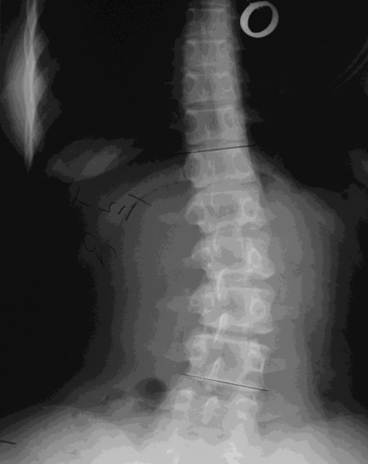
Figure 1: Thoraco-lumbar radiograph of 1st twin with left scoliosis from T12 to L4.
Examination of her identical twin sister, who was accompanying her sister, revealed an identical curve concave to the left. Her X-ray radiograph demonstrated a concave left thoraco-lumbar scoliosis centred at L2 vertebra with a Cobb angle of 16 degrees (Figure 2).
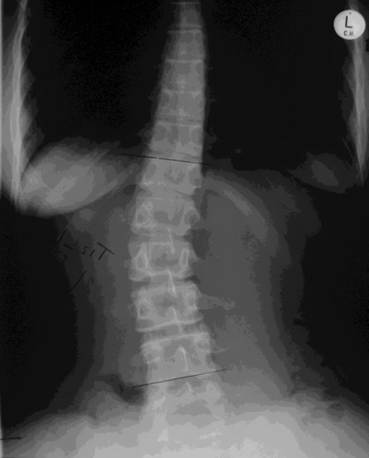
Figure 2: Thorco-lumbar radiograph of 2nd twin with right scoliosis from T12 to L4 mirror Image to the 1st twin.
Both sisters were pre-menarche and were of normal pregnancy, normal birth and normal developmental milestones.
At the 3 years post presentation follow up, both sisters continued to remain asymptomatic and have a well-balanced spine. Their X-ray radiographs demonstrated both to be at Risser stage IV with thoraco-lumbar scoliosis to the right and left respectively with a Cobb angle of 16 degrees.
Discussion
The exact aetiology of AIS is not clear. Most authors suggest that the evidence for a polygenic aetiology is growing. In this reported case, a set of monozygotic twins interestingly had identically opposite thoraco lumbar scolioses. Studies have revealed a higher rate of concordance of AIS in monozygotic twins than dizygotic, but the rate of concordance is not 100%, leading various authors to conclude that the aetiology is of a polygenic inheritance pattern. [3,4] In a meta-analysis Kesling found a concordance rate of 73% among monozygotic twins and 36% among dizygotic twins[3]. In the vast majority of both monozygotic and dizygotic twins with AIS, the direction of scoliosis in the coronal plane is the same side. There have been three reported cases of mirroring, two in dizygotic twins and one in teenage siblings. [5,6] In these reported cases the degree of scoliosis has been different in each twin.
Other developmental and pathological conditions with mirror- image in monozygotic twins has been reported in isolated case reports in different parts of the body and different pathological conditions. They include solitary bone cysts of humerus [7], dental anomalies [8], brachial arch syndrome in the face, [9], myopic anisometropia in the eyes [10], posterior urethral valves [11] and adenocarcinoma of the lungs [12]. We add Idiopathic scoliosis of the spine in this case.
Cytogenic factors have been suggested for their pathogenesis. However, fluctuating asymmetry has not been discussed as a possible mechanism and explanation for their mirror-image presentation.
In our case, we propose fluctuating asymmetry is a good explanation for the mirror- image development of the deformity. Fluctuating asymmetry is the asymmetry that results from the inability of organisms to develop in precisely determined paths. Fluctuating asymmetry is undoubtedly ubiquitous. It might be expected to and in fact, usually does result in a normal (or binomial) distribution of the signed differences between the sides and an equal mean development on each side [13].
The aetiology of AIS is more complicated than a straightforward polygenic inheritance. However, the developmental role in the aetiology of scoliosis is underreported as intrauterine events can have a significant determination upon the development of scoliosis. Floman in his case report scoliotic mirror imaging in siblings and suggested that a single gene mutation is responsible for these anomalies but he did not explain the element of ‘mirror imaging’. He stated that environmental factors cannot be excluded as contributing to the development of these spinal anomalies in utero [5].
Veldhuizen, et al. proposed a two stage developmental cause of scoliosis initially a small defect in the neuromuscular control system and in the second stage during adolescent growth in which the scoliotic curve is exacerbated by biomechanical factors [14].
Fluctuating Asymmetry has been suggested as a mechanism of asymmetrical development. It is commonly used to estimate the effects of minor developmental accidents. These accidents differ between individuals, and there is also an individual difference in resistance to these accidents or level of developmental instability. Developmental instability (DI) has been described as the inability of an organism to buffer its development adequately against random biological signal of (genetic) quality. As increased development instability (DI) increases, the morphological asymmetries as a fluctuating asymmetry (FA) increases [15]. In experimental biology several studies on asymmetrical developments in insects and its relation to the fluctuating asymmetry induced by environmental stresses has been reported [16,17].
In human developmental asymmetry, Woolf and Gianas studied fluctuating asymmetry in cleft lip propositi, their normal sibs, parents, and the increased fluctuating asymmetry among them [18]. Others subsequently looked at its relation in other developmental abnormalities as an asymmetry in relation to facial skeletal asymmetry during foetal development [19,20], dental development asymmetry and human femur asymmetry [21] and vertebral malformation of the spine[22].
Goldberg et al also looked at adolescent idiopathic scoliosis as a development instability resulting in a loss of symmetry during growth and its association with palmer dermoglyphics [23].
Although monozygotic twins come from the same zygote, their intrauterine environment may be markedly different. Cleavage can take place at differing times during development resulting in uneven distribution of cytoplasmic components of the egg, subsequently affecting the postzygotic maturation of the foetus. This has been the explanation for differential congenital abnormalities in monozygotic twins [22]. These differences in postzygotic maturation and the developmental instability may be the cause of the mirroring in this case presenting as a fluctuating asymmetry development [23-25].
Most recently, González-Ruiz JM et al looked on how can fluctuating asymmetry help on the prognosis of scoliosis along its progression course [26]. Floman in his paper discussion suggested that a single gene mutation is responsible for these anomalies but did not explain the element of ‘mirror imaging’ and he further stated that environmental factors cannot be excluded as contributing to the development of these spinal anomalies in utero [5]. Our paper report this rare case and introduce these contributing environmental factors and suggest a possible explanatory mechanism by the well-established Developmental Incidence theory and the mirror imaging by Fluctuating Asymmetry in developmental biology.
References
- DeGeorge FV, Fisher RL. (1967). Idiopathic scoliosis: genetic and environmental aspects. J Med Genet. 4:25 1-57.
- Wynne-Davies R. (1968). Familial (idiopathic) scoliosis: A family survey. J Bone Joint Surg [Br]. 50:24-30.
- Kesling KL, Reinker KA. Scoliosis in twins. Spine. 1997:17;2009-15
- Inoue M, Minami S, Kitahara H, Otsuka Y, Nkata Y, et al. (1998). Idiopathic scoliosis in twins studied by DNA fingerprinting: the incidence and type of scoliosis. J Bone Joint Surg [Br]. 80: 212-77.
- Goto T, Nemoto T, Okuma T, Kobayashi H, Funata N. (2008). Mirrorimage solitary bone cyst of the humerus in a pair of mirror-image monozygotic twins. Arch Orthop Trauma Surg. 128: 1403-6.
- Carton A, Rees RT. (1987). Mirror image dental anomalies in identical twins. Br.Dent J. 162: 193-194.
- Satoh K, Shibata Y, Tokushige H, Onizuka T. (1995). A mirror image of the first and second branchial arch syndrome associated with cleftl.gruS tsalP J rB.sniwt citogyzonom ni etalap dna pi599506-106 :84.
- Okamoto F, Nonoyama T, Hommura S. (2001). Mirror image myopicanisometropia in two pairs of monozygotic twins. Ophthalmologica.215: 435-8.
- Morini F, Ilari M, Casati A, Pisera A, Oriolo L, et al. (2002). Posteriorurethral valves and mirror image anomalies in monozygotic twins. Am J Med Genet. 111: 210-2.
- Morison D, Reyes CV, Skorodin MS. (1994). Mirror-image tumours in mirror-image twins. Chest. 106: 608-610.
- Van Valen L. (1962). A study of fluctuating asymmetry. Evolution. 16: 125 142.
- Veldhuizen GA, Wever DJ, Webb PJ. (2000). The aetiology of idiopathic scoliosis: biomechanical and neuromuscular factors. Eur Spine J. 9: 178–184.
- Møller AP, Manning J. (2003). Growth and developmental instability.Vet J. 166: 19-27.
- Symanski C, Redak RA. (2021). Does fluctuating asymmetry of wing traits capture relative environmental stress in a lepidopteran? Ecol Evol. 11: 1199-1213.
- Betzholtz, E. (2000). Genetic status and fluctuating asymmetry in an endangered population of the moth Dysauxes acilla L. (Lepidoptera: Ctenuchidae). Journal of Insect Conservation. 4: 93-98.
- Woolf CM, Gianas, AD (2019). Congenital Cleft Lip and Fluctuating Dermatoglyphic Asymmetry Orthod Craniofac Res. 1:199-206.
- Katsube M, Rolfe SM, Bortolussi SR, Yamaguchi Y, Richman JM, et al. (2019). Analysis of facial skeletal asymmetry during foetlal development using μCT imaging. Orthod Craniofac Res. 22: 199-206.
- Gateño J, Jones TL, Shen SGF, Chen KC, Jajoo A, et al. (2018). Fluctuating asymmetry of the normal facial skeleton. Int J Oral Maxillofac Surg. 47: 534-540.
- Mopin C, Chaumoître K, Signoli M, et al. Developmental stability and environmental stress: A geometric morphometrics analysis of asymmetry in the human femur. Am J Hum Genet 1976 Jul;28(4):4003.
- Goldberg CJ, Fogarty EE, Moore DP, Dowling FE. (1997). Fluctuating Asymmetry and Vertebral Malformation. A Study of PalmarDermatoglyphics in Congenital Spinal Deformities. Spine. 22: 775-9.
- Goldberg CJ, Dowling FE, Fogarty EE, Moore DP. (1995). Adolescent Idiopathic Scoliosis as Developmental Instability. Genetica. 96: 24755.
- Goldberg CJ, Fogarty EE, Moore DP, Dowling FE. (1997). Scoliosis and Developmental Theory: Adolescent Idiopathic Scoliosis. Spine (Phila Pa 1976). 22: 2228-37; discussion 2237-8.
- González-Ruiz JM, Pérez-Núñez MI, García-Alfaro, Bastir M. (2021). How can directional and fluctuating asymmetry help in the prognosis of scoliosis along the course of the condition? J Anat. 239: 1400-1408.